> For the complete documentation index, see [llms.txt](https://help.leadboxer.com/leadboxer/llms.txt). Markdown versions of documentation pages are available by appending `.md` to page URLs; this page is available as [Markdown](https://help.leadboxer.com/leadboxer/integrations/other/how-to-get-started-with-leadboxer-on-zapier/advanced-zapier-usage.md).
# Advanced Zapier usage
In this document we will give an example on how to use Zapier to talk to our API and perform complex or out of the box implementations
In this example case, a customer wanted to assign a lead in LeadBoxer based on the owner in their CRM (in this case Pipeline Deals)
This can be accomplished by setting up Zapier with these 5 steps (and you can make this more complex obviously if you need ;-)
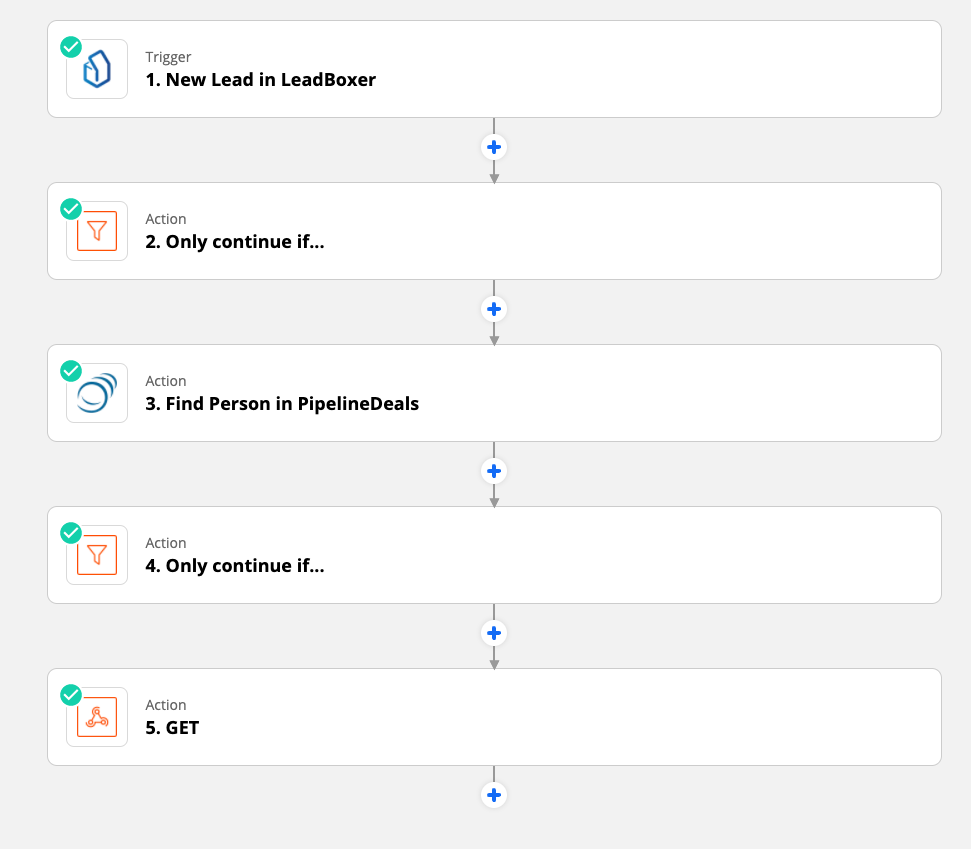
Here are the detailes for each step:
1\. Setup the LeadBoxer trigger and provide API key and select the correct dataset (website)
2\. Add a filter (you can also add these later) to make sure the actions are only performed when a key event happens. In this case when a lead with a known email and a specific lead tag enters the system
3\. Find the person / lead in the CRM based on the email (you can optionally create the person /deal/ etc but this is outside the scope of this tutorial)
4\. Again you need a filter to match the owner ID of the person/lead/contact to the user ID in LeadBoxer. This also means you need to make a separate zap (duplicate) for each user/owner combination.
5\. This is the most complex step, as it creates an API call to LeadBoxer and sets the 'assignee'. Add the **Webhooks by Zapier** app and select the **Custom Request** action event.
Then configure the webhook to call the [Assign Leads](https://developers.leadboxer.com/reference) call of the LeadBoxer API:
* **Method:** `PUT`
* **URL:** `https://api.leadboxer.com/v1/management/assign-leads`
* **Data** (JSON):
```json
{
"leadId": "",
"datasetId": "",
"assignee":
}
```
* **Headers:** `x-api-key` with your LeadBoxer API key, and `Content-Type` with `application/json`
You find your API key in LeadBoxer under [Integrations → API key](https://app.leadboxer.com/integrations-connectors/data/api-key).
Thats it
Now for every new lead (or existing lead with new activity)in leadboxer, where the email is known and the tag is set to team, we will search for that person in Pipedrive Deals, and assign the lead if the owner matches the filter.
You can of course also contact us and ask for our help
---
# Agent Instructions
This documentation is published with GitBook. GitBook is the documentation platform designed so that both humans and AI agents can read, navigate, and reason over technical content effectively. Learn more at gitbook.com.
## Querying This Documentation
If you need additional information that is not directly available in this page, you can query the documentation by asking a question.
Perform an HTTP GET request on the following URL with the `ask` and `goal` query parameters:
```
GET https://help.leadboxer.com/leadboxer/integrations/other/how-to-get-started-with-leadboxer-on-zapier/advanced-zapier-usage.md?ask=&goal=
```
`ask` is the immediate question: it should be specific, self-contained, and written in natural language.
`goal` is what the user is ultimately trying to achieve, the reason they need the answer. Sharing it helps GitBook give you a better, more relevant answer. A goal is most helpful when it describes the outcome the user wants rather than restating the question. For example, with `ask=how do I create an API token`, a goal like `automate deployments from our CI pipeline` lets GitBook tailor the answer to that use case.
The response will contain a direct answer to the question and relevant excerpts and sources from the documentation.
Use this mechanism when the answer is not explicitly present in the current page, you need clarification or additional context, or you want to retrieve related documentation sections.


