> For the complete documentation index, see [llms.txt](https://help.leadboxer.com/leadboxer/llms.txt). Markdown versions of documentation pages are available by appending `.md` to page URLs; this page is available as [Markdown](https://help.leadboxer.com/leadboxer/integrations/other/n8n.md).
# n8n
Connect LeadBoxer with n8n
This guide shows how to pull your LeadBoxer App leads into an n8n workflow. For API-first automations, see [n8n and Make automation](https://www.leadboxer.com/integrations/automation) and the [n8n guide on the developer portal](https://developers.leadboxer.com/docs/n8n).
{% hint style="info" %}
Only need company details for a domain or IP address? Install the LeadBoxer community node instead: in n8n go to **Settings > Community Nodes**, select **Install** and enter `n8n-nodes-leadboxer`. It adds Domain Lookup and IP Address Lookup operations. The steps below pull your leads with the HTTP Request node.
{% endhint %}
Step 1
Add a scheduled Trigger, to query the LeadBoxer API for fresh results. We recommend to set this to every 10 minutes or so, depending on your traffic volumes.
Step 2
Add the HTTP Request node
Step 3
in the HTTP node settings:
* Method = GET
* URL: `https://api.leadboxer.com/v1/leads?site=YOUR_DATASET_ID&timeField=eventEsTimestamp&criteriaTimeFilter=eventEsTimestamp%7Cexactly%7C0&criteriaDisplayFilter=company&sortBy=lastEvent%7Cdesc&limit=50`
This returns up to 50 identified companies seen today, newest first. Replace `YOUR_DATASET_ID` with your dataset ID. To change the period use for example `criteriaTimeFilter=eventEsTimestamp%7Clessthan%7C6` (last 7 days); `%7C` is the `|` character, which must be URL-encoded. All parameters are described in the [API reference](https://developers.leadboxer.com) under Retrieve Leads.
*
```
```
* Set authentication
First you need to get your API key inside the LeadBoxer App from integrations > data\
Give the key a name, paste the LeadBoxer API key, set the placement to **in the header** and the parameter name to **x-api-key**.
{% hint style="info" %}
The screenshots show an older setup with the key in the query string. The public API expects the key in the `x-api-key` header.
{% endhint %}
step 4
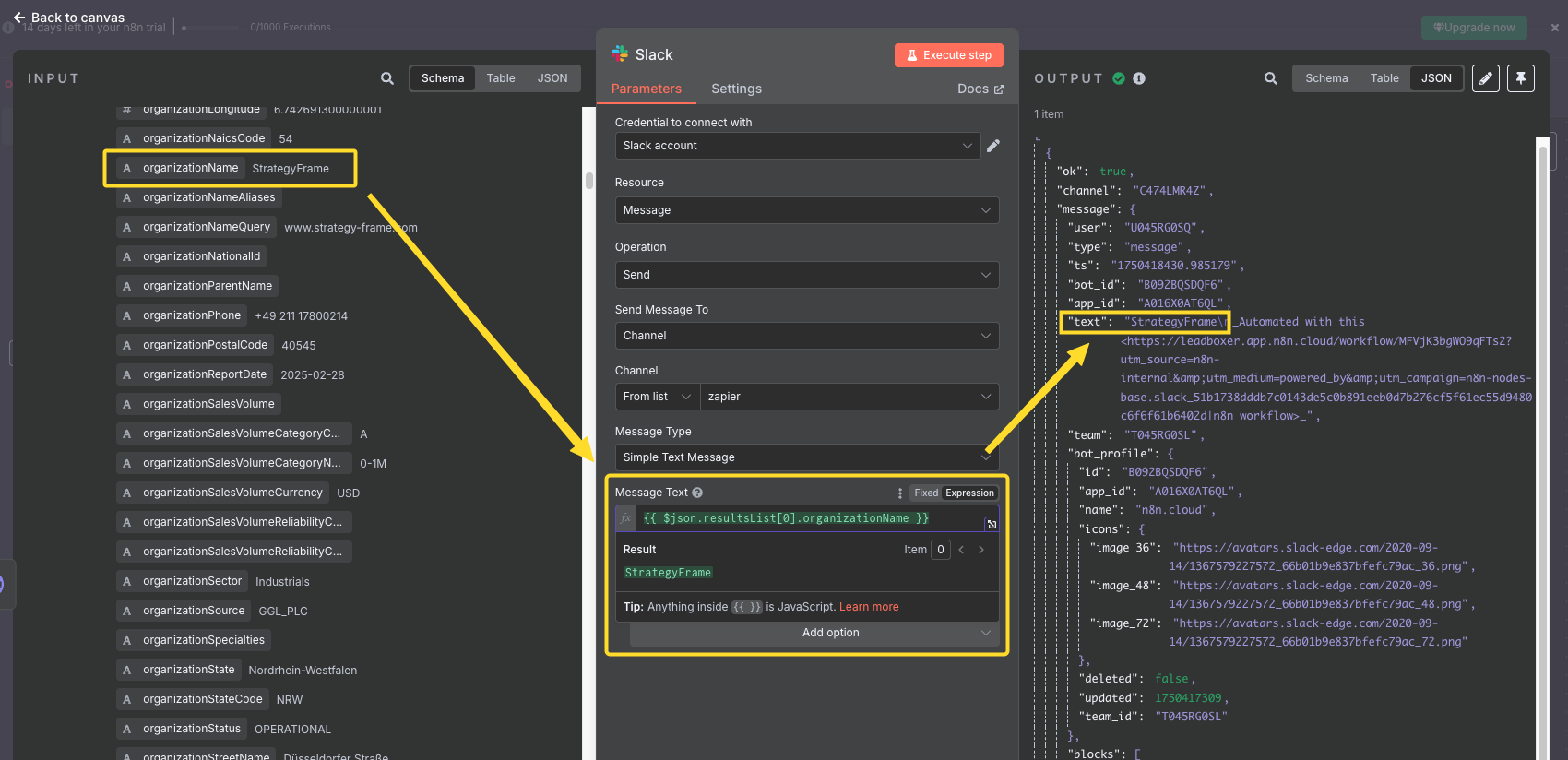
You can now add other nodes to your canvas and access data from LeadBoxer, you can see the data in output
Here is an example using Slack, adding identified companies to a slack channel
Make sure to use the fields that start with organisation\*
---
# Agent Instructions
This documentation is published with GitBook. GitBook is the documentation platform designed so that both humans and AI agents can read, navigate, and reason over technical content effectively. Learn more at gitbook.com.
## Querying This Documentation
If you need additional information that is not directly available in this page, you can query the documentation by asking a question.
Perform an HTTP GET request on the following URL with the `ask` and `goal` query parameters:
```
GET https://help.leadboxer.com/leadboxer/integrations/other/n8n.md?ask=&goal=
```
`ask` is the immediate question: it should be specific, self-contained, and written in natural language.
`goal` is what the user is ultimately trying to achieve, the reason they need the answer. Sharing it helps GitBook give you a better, more relevant answer. A goal is most helpful when it describes the outcome the user wants rather than restating the question. For example, with `ask=how do I create an API token`, a goal like `automate deployments from our CI pipeline` lets GitBook tailor the answer to that use case.
The response will contain a direct answer to the question and relevant excerpts and sources from the documentation.
Use this mechanism when the answer is not explicitly present in the current page, you need clarification or additional context, or you want to retrieve related documentation sections.