> For the complete documentation index, see [llms.txt](https://help.leadboxer.com/leadboxer/llms.txt). Markdown versions of documentation pages are available by appending `.md` to page URLs; this page is available as [Markdown](https://help.leadboxer.com/leadboxer/capture-website-and-email/email/marketing-emails/brevo.md).
# Brevo
NOTE: Brevo was previously known as Sendinblue.\
\
This tutorial tells you how to use LeadBoxer email tracking to identify visitors clicking from your Brevo emails.
Leadboxer will show you the email and website behaviour of the person who opened and clicked through the links in your email, simply by adding a special link in the emails sent and adding code to the landing page.
Technical requirements:
1. LeadBoxer account
2. Brevo account
Steps:
1. Customise the links in your email newsletter
2. Install the email tracking pixel
Assuming you fulfilled both requirements, let's proceed to step 1.
### Step 1
Capturing data from your email readers involves a small change to your normal workflow.
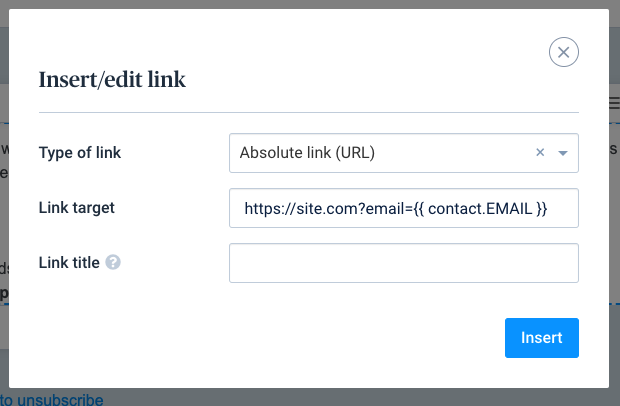
Create your emails like you always do, and modify all the links that go to the pages of your website. If our tracking code is on these pages, it will automatically capture the information being sent from the Brevo email once they click a link.
When your email is ready, add dynamic fields to your links as parameters.
Here is the minimal version of what you need to add:
```
?email={{ contact.EMAIL }}
```
This will append the email address to the url of the landing page. You can do this for all fields available in Brevo eg:
```
?email={{ contact.EMAIL }}&firstName={{ contact.FIRSTNAME }}&lastName={{ contact.LASTNAME }}
```
Save your email, and test the links by sending yourself a copy, you should see the email address and other fields appended to the url on your landing page. The following image shows what you should see appended to the url of your landing page:
### Step 2
Next, you will need to add the LeadBoxer email tracking pixel so that we can also track email opens and get information on how often customers read your emails.
In the Editor, use the HTML content block to add the tracking pixel. Place this block at the bottom of your email content.
We recommend to compose the pixel in a text-file before using pasting it in the actual email.
You can use below snippet as starting point. Make sure to replace the DatasetID with your own and if needed, update the campaign value with the correct campaign name.
{% code overflow="wrap" %}
```html
```
{% endcode %}
It's always a good idea to test this thoroughly before sending this to you main lists. If things are working, you'll see the emails of leads interested in your newsletter's landing page.
For more documentation, you can read:
---
# Agent Instructions
This documentation is published with GitBook. GitBook is the documentation platform designed so that both humans and AI agents can read, navigate, and reason over technical content effectively. Learn more at gitbook.com.
## Querying This Documentation
If you need additional information that is not directly available in this page, you can query the documentation by asking a question.
Perform an HTTP GET request on the following URL with the `ask` and `goal` query parameters:
```
GET https://help.leadboxer.com/leadboxer/capture-website-and-email/email/marketing-emails/brevo.md?ask=&goal=
```
`ask` is the immediate question: it should be specific, self-contained, and written in natural language.
`goal` is what the user is ultimately trying to achieve, the reason they need the answer. Sharing it helps GitBook give you a better, more relevant answer. A goal is most helpful when it describes the outcome the user wants rather than restating the question. For example, with `ask=how do I create an API token`, a goal like `automate deployments from our CI pipeline` lets GitBook tailor the answer to that use case.
The response will contain a direct answer to the question and relevant excerpts and sources from the documentation.
Use this mechanism when the answer is not explicitly present in the current page, you need clarification or additional context, or you want to retrieve related documentation sections.

.png?alt=media)